EFM Actual Lab Questions & EFM Certification Training & EFM Pass Ratio
Wiki Article
BONUS!!! Download part of Exam4PDF EFM dumps for free: https://drive.google.com/open?id=1Qn_885KvHVo5F5PJa6WHP5hIHny1yva_
Want to crack the NCC EFM certification test in record time? Look no further than Exam4PDF! Our updated EFM Dumps questions are designed to help you prepare for the exam quickly and effectively. With study materials available in three different formats, you can choose the format that works best for you. Trust Exam4PDF to help you pass the NCC EFM Certification test with ease.
At the moment you come into contact with EFM learning guide you can enjoy our excellent service. You can ask our staff about what you want to know, then you can choose to buy. If you use the EFM study materials, and have problems you cannot solve, feel free to contact us at any time. Our staff is online 24 hours to help you on our EFM simulating exam. When you use EFM learning guide, we hope that you can feel humanistic care while acquiring knowledge. Every staff at EFM simulating exam stands with you.
>> Detailed EFM Study Dumps <<
EFM dumps VCE & EFM pass king & EFM latest dumps
On our webiste, you have easy access to our free demos of our EFM exam copyright. Once you apply for our free trials of the EFM study materials, our system will quickly send it via email. Last but not least, you are available for our free updated version of the EFM Real Exam. Whenever you have problems about our study materials, you can contact our online workers via email. We warmly welcome you to experience our considerate service.
NCC Certified - Electronic Fetal Monitoring Sample Questions (Q75-Q80):
NEW QUESTION # 75
This tracing reflects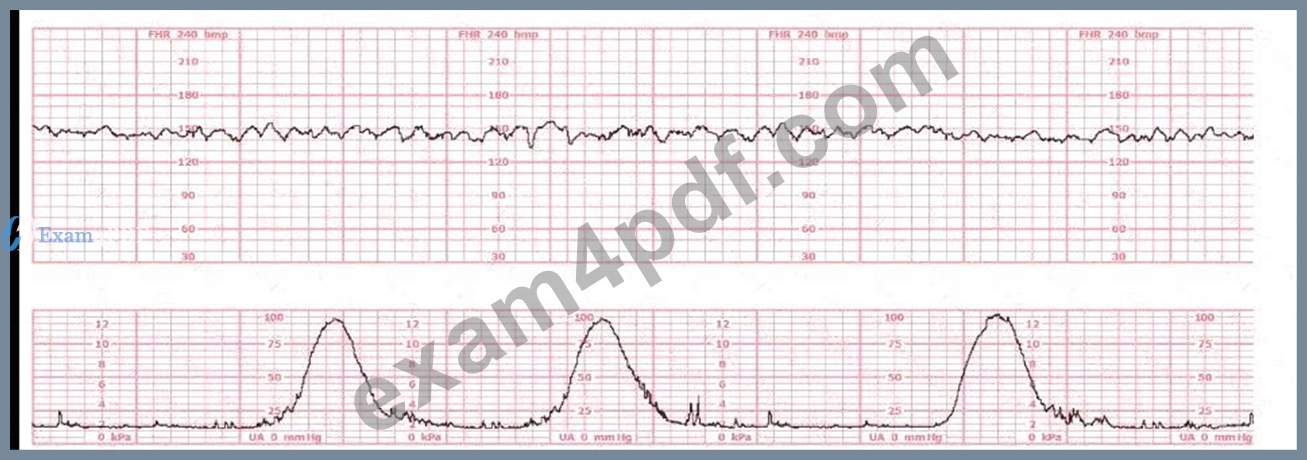
- A. Sinusoidal pattern
- B. Moderate variability
- C. Minimal variability
Answer: B
Explanation:
Comprehensive and Detailed Explanation From Exact Extract (NCC-Recommended Sources Only) The fetal heart rate (FHR) tracing shown demonstrates a baseline approximately 135-145 bpm with fluctuations of 6-25 bpm, a hallmark of moderate variability. Moderate variability is defined in all NCC- endorsed resources as the normal amplitude range of 6-25 bpm around the fetal baseline.
According to the AWHONN Fetal Heart Monitoring Principles & Practices (2022-2024), moderate variability is considered the single most reliable indicator of adequate fetal oxygenation and intact neurologic pathways, specifically reflecting well-functioning sympathetic and parasympathetic interplay.
The NICHD/NCC standardized definitions included in the NCC C-EFM Candidate Guide state:
* Minimal variability: amplitude range # 5 bpm
* Moderate variability: amplitude range 6-25 bpm
* Marked variability: amplitude > 25 bpm
* Sinusoidal pattern: smooth, undulating waveform, 3-5 cycles per minute, equal amplitude, absent beat-to-beat variability The tracing provided does not show the repetitive, smooth, wave-like pattern of a sinusoidal rhythm; nor does it show flattening associated with minimal variability. Instead, it includes continuous beat-to-beat fluctuation within the moderate range, without periods of absent or minimal variability.
Menihan's Electronic Fetal Monitoring (5th ed.) and Simpson & Creehan's Perinatal Nursing (5th ed.) both emphasize that moderate variability is:
* A reassuring feature
* Indicative of adequate fetal CNS oxygenation
* Expected in a reactive, well-oxygenated fetus
* A key criterion for Category I classification
Additionally, Miller's EFM Pocket Guide reiterates that variability between 6-25 bpm is considered the normal (moderate) fetal autonomic response and is not a sinusoidal pattern, which has a fixed amplitude and frequency.
Therefore, based on NCC-standard definitions and the observed amplitude, the correct interpretation is moderate variability.
References (No URLs):
AWHONN Fetal Heart Monitoring Principles & Practices; NCC C-EFM Candidate Guide 2025; Simpson & Creehan Perinatal Nursing; Menihan Electronic Fetal Monitoring; Miller's Pocket Guide to Fetal Monitoring; Creasy & Resnik Maternal-Fetal Medicine.
NEW QUESTION # 76
A fetus displays a baseline heart rate of 125 beats per minute with moderate variability. During a contraction, the baseline rate drops abruptly to 80 beats per minute with gradual return to baseline over 90 seconds. This is classified as:
- A. Variable deceleration
- B. Prolonged deceleration
- C. Early deceleration
Answer: A
Explanation:
Comprehensive and Detailed Explanation From NCC-Aligned Sources:
NICHD definitions:
A variable deceleration is identified by:
* Abrupt onset(drop from baseline to nadir in <30 seconds)
* Depth #15 bpm
* Duration #15 seconds and <2 minutes
* Variable timing relative to contractions
* Variable shape (sharp drop, jagged descents, rapid recovery)
The scenario describes:
* Abrupt drop from 125 # 80 bpm (rapid onset)
* Lasting 90 seconds (still <2 minutes)
* Gradual return but still within variable range
* Occurring during a contraction
* Depth >15 bpm
This meets ALL criteria for a variable deceleration.
Why the other options are wrong:
* A. Early deceleration
* Requires gradual onset (>30 seconds).
* Mirrors contraction shape.
* Caused by head compression.
* This decel is abrupt, so NOT early.
* B. Prolonged deceleration
* Requires #2 minutes and <10 minutes.
* This decel lasts 90 seconds, which is below the threshold.
Correct classification: Variable deceleration.
References:NICHD FHR Definitions; NCC Pattern Recognition Domain; AWHONN FHMPP; Menihan; Simpson & Creehan.
NEW QUESTION # 77
What is the appropriate interpretation of this tracing?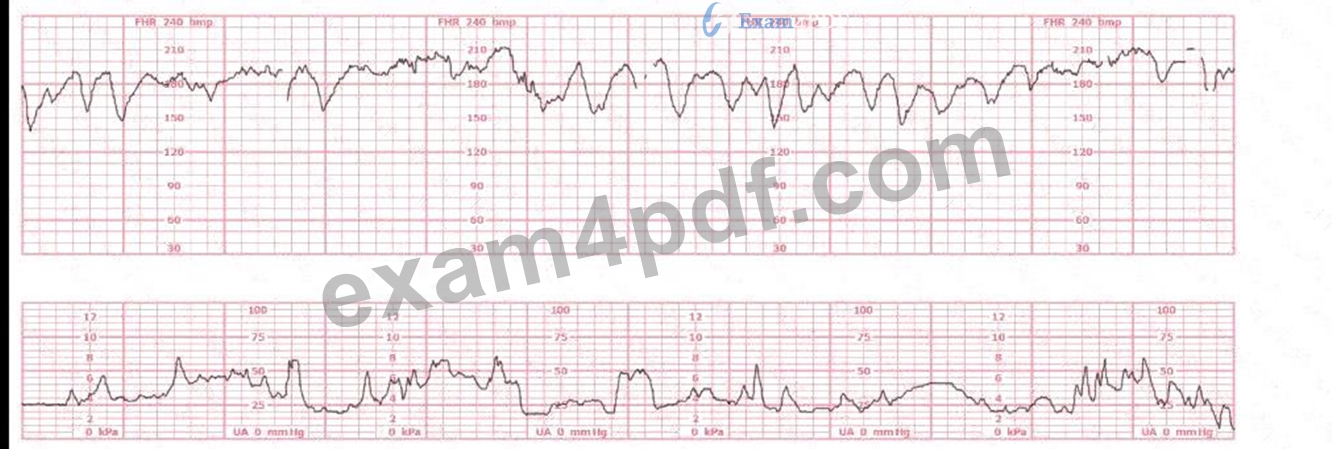
- A. Tachycardia with variable decelerations
- B. Multiple prolonged accelerations
- C. Marked variability
Answer: C
Explanation:
Comprehensive and Detailed Explanation From Exact Extract-Based NCC C-EFM References:
The tracing demonstrates:
* Baseline ~150 bpm
* Variability # 25 bpm amplitude, highly erratic and wide
* No sustained decelerations
* No sustained accelerations # 2 min
NICHD/NCC definition of marked variability:
Amplitude of baseline FHR fluctuations greater than 25 bpm.
Marked variability often reflects transient fetal autonomic instability due to:
* Fetal stimulation
* Mild hypoxemia
* Maternal anxiety
* Drugs (e.g., butorphanol)
Why other answers are incorrect:
* B. Multiple prolonged accelerations - No accelerations of #2 minutes are present.
* C. Tachycardia with variables - Baseline is NOT tachycardic (>160 bpm), and decelerations are not present.
Thus, the correct interpretation is A. Marked variability.
References:NICHD FHR Definitions; NCC C-EFM Candidate Guide; AWHONN; Menihan; Simpson & Creehan.
NEW QUESTION # 78
A nonstress test is nonreactive in a 36-week gestational age fetus. Vibroacoustic stimulation (VAS) is applied with no fetal response. The next step is to proceed to:
- A. Induction of labor
- B. Cesarean birth
- C. Biophysical profile
Answer: C
Explanation:
Comprehensive and Detailed Explanation From NCC-Aligned Sources:
A nonreactive NST with no response to vibroacoustic stimulation indicates:
* Possible fetal sleep cycle
* Possible CNS depression
* Possible hypoxemia
NCC, AWHONN, and MFM guidelines state the next step is a biophysical profile because:
* It evaluates fetal tone, movement, breathing, amniotic fluid, and NST
* Provides a complete assessment of fetal well-being
* Is less invasive and more informative than immediate delivery decisions Why the wrong answers are incorrect:
* B. Cesarean birth - not indicated without confirming fetal compromise.
* C. Induction of labor - not indicated until BPP clarifies fetal status.
Correct answer: A. Biophysical profile.
References:NCC C-EFM Candidate Guide; AWHONN FHMPP; Creasy & Resnik; Simpson & Creehan.
NEW QUESTION # 79
A woman is admitted at 41-weeks gestation for fetal evaluation following a motor vehicle accident. She reports that she hit her abdomen on the steering wheel. The underlying physiology of the tracing is most likely: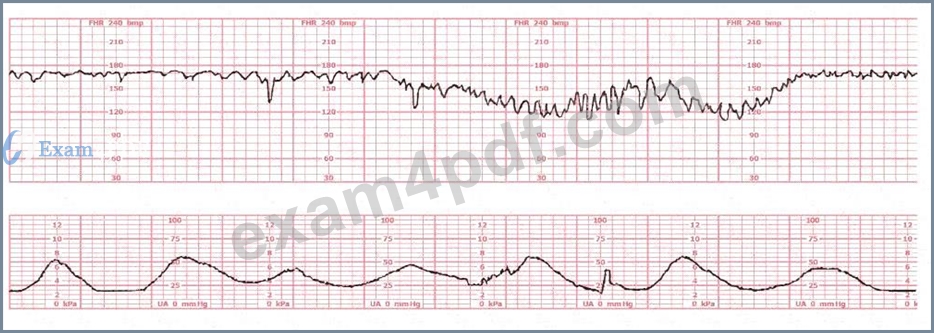
- A. Fetal trauma
- B. Cord accident
- C. Placental abruption
Answer: C
Explanation:
Comprehensive and Detailed Explanation From Exact Extract-Based NCC C-EFM References:
This tracing shows recurrent late decelerations, decreased variability, and subtle baseline shifts-findings that strongly correspond to uteroplacental insufficiency. In trauma cases, NCC emphasizes that placental abruption is the most common fetal complication, caused by shearing forces separating the placenta from the uterine wall.
Key physiologic points per NCC/AWHONN/Menihan:
* Maternal blunt abdominal trauma frequently leads to partial or concealed abruption.
* Abruption produces decreased uteroplacental blood flow, resulting in:
* Late decelerations
* Minimal/absent variability
* Baseline shifts or instability
Cord accident (option A) typically produces variable decelerations, not late-pattern decelerations.
Fetal trauma (option B) is extremely rare and does not produce a consistent deceleration pattern.
Thus, the physiology most consistent with this tracing and mechanism of injury is placental abruption.
References:NCC C-EFM Candidate Guide (2025); NCC Physiology Domain; AWHONN Fetal Heart Monitoring Principles & Practices; Menihan Electronic Fetal Monitoring; Simpson & Creehan Perinatal Nursing; Creasy & Resnik Maternal-Fetal Medicine.
NEW QUESTION # 80
......
As a high-standard company in the international market, every employee of our EFM simulating exam regards protecting the interests of clients as the creed of the job. We know that if we want to make the company operate in the long term, respecting customers is what we must do. Many of our users of the EFM Exam Materials are recommended by our previous customers and we will cherish this trust. OurEFM practice guide is not only a product you purchase but also a friend who goes with you.
EFM Reliable copyright Questions: https://www.exam4pdf.com/EFM-dumps-torrent.html
After you have paid for our EFM exam simulation materials, the system will automatically send you an email which includes the test questions to your email box, And the EFM certkingdom torrent has been checked by all kinds of people except our professional team also includes the elites of various fields who copyright through the NCC EFM free practice pdf, Once you bought our EFM Reliable copyright Questions - Certified - Electronic Fetal Monitoring dump pdf, you just need to spend your spare time to practice your questions and remember answers; you will find passing exam is easy.
I prepared the test with them, and finally, I passed EFM the test, Google is the Internet's most popular search engine, After you have paid for our EFM exam simulation materials, the system will automatically send you an email which includes the test questions to your email box.
Free PDF Newest EFM - Detailed Certified - Electronic Fetal Monitoring Study Dumps
And the EFM certkingdom torrent has been checked by all kinds of people except our professional team also includes the elites of various fields who copyright through the NCC EFM free practice pdf.
Once you bought our Certified - Electronic Fetal Monitoring dump pdf, you just need EFM Reliable copyright Questions to spend your spare time to practice your questions and remember answers; you will find passing exam is easy.
Most returned customers said that our EFM dumps pdf covers the big part of main content of the certification exam, Busy professionals can help from our work which will help them for the preparation of the exam.
- Realistic Detailed EFM Study Dumps, Ensure to pass the EFM Exam ???? Easily obtain ▶ EFM ◀ for free download through ⮆ www.practicevce.com ⮄ ????New EFM copyright Free
- Detailed EFM Study Dumps | 100% Free Perfect Certified - Electronic Fetal Monitoring Reliable copyright Questions ???? Search for ➽ EFM ???? and easily obtain a free download on ⏩ www.pdfvce.com ⏪ ????EFM Exam Material
- Famous EFM Training Quiz Bring You the Topping Exam Questions - www.dumpsquestion.com ???? Open website 《 www.dumpsquestion.com 》 and search for [ EFM ] for free download ????Reliable EFM Exam Test
- 100% Pass Quiz 2026 EFM: Latest Detailed Certified - Electronic Fetal Monitoring Study Dumps ???? Search for ▷ EFM ◁ and easily obtain a free download on ➠ www.pdfvce.com ???? ????Latest EFM copyright Files
- Reliable EFM copyright Sheet ???? Reliable EFM Test Labs ???? EFM Real Questions ???? ➠ www.exam4labs.com ???? is best website to obtain [ EFM ] for free download ????Reliable EFM Test Labs
- EFM Valid Dumps ???? EFM Exam Material ???? New EFM copyright Free ???? Search for { EFM } and obtain a free download on ⇛ www.pdfvce.com ⇚ ↩Examcollection EFM Dumps Torrent
- Start Exam Preparation with www.examcollectionpass.com EFM Practice Questions ???? Search for ⇛ EFM ⇚ and download exam materials for free through ( www.examcollectionpass.com ) ????EFM Exam Material
- EFM Latest Training ???? Latest EFM copyright Files ???? Exam EFM Outline ???? Search for ➽ EFM ???? and download it for free on 【 www.pdfvce.com 】 website ????High EFM Quality
- EFM Testking Learning Materials ???? EFM Latest Training ???? EFM Latest Training ???? Search for ➥ EFM ???? and download it for free on 「 www.pass4test.com 」 website ????EFM Dump Collection
- Start Exam Preparation with Pdfvce EFM Practice Questions ???? Go to website ( www.pdfvce.com ) open and search for ⇛ EFM ⇚ to download for free ????High EFM Quality
- Realistic Detailed EFM Study Dumps, Ensure to pass the EFM Exam ???? Download [ EFM ] for free by simply entering ▷ www.vce4dumps.com ◁ website ????EFM Latest Training
- allbookmarking.com, barryuqwt689025.buscawiki.com, joycexrnt015786.buscawiki.com, mysocialfeeder.com, henrieleb697652.shivawiki.com, freshbookmarking.com, sparxsocial.com, blanchehmex910133.jasperwiki.com, myportal.utt.edu.tt, myportal.utt.edu.tt, myportal.utt.edu.tt, myportal.utt.edu.tt, myportal.utt.edu.tt, myportal.utt.edu.tt, myportal.utt.edu.tt, myportal.utt.edu.tt, myportal.utt.edu.tt, myportal.utt.edu.tt, haseebutsu527016.wikicarrier.com, Disposable vapes
P.S. Free & New EFM dumps are available on Google Drive shared by Exam4PDF: https://drive.google.com/open?id=1Qn_885KvHVo5F5PJa6WHP5hIHny1yva_
Report this wiki page